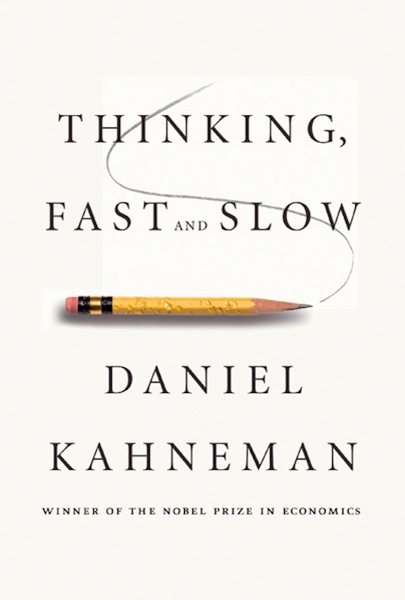
Chapter 1 of 1

Two Minds, One Wallet

"Ten cents," my friend Dana said. She did not even look up from her coffee.

I had just given her Kahneman's famous puzzle. A bat and a ball cost $1.10 together. The bat costs one dollar more than the ball. How much is the ball?

"Check the math," I said.

She frowned. Then she groaned.

"If the ball is ten cents, the bat is $1.10. That's $1.20 total. It's five cents. Why did I say ten?"

"Because two minds live in your head," I said. "The fast one answered before the slow one woke up."

That split is the whole book.

System 1 is fast, automatic, always on. It reads faces, finishes song lyrics, blurts "ten cents."

System 2 is slow, careful, and lazy. It can do the math. It would rather not. Most of the time it just approves whatever System 1 hands it.

System 1, the fast mind

  • always on
  • effortless
  • jumps to answers
  • runs on gut feel
vs

System 2, the slow mind

  • lazy
  • costs effort
  • checks the work
  • only shows up when called

Dana felt better when I gave her the numbers. More than half the students Kahneman tested at Harvard, MIT, and Princeton got it wrong too.

50%+share of students at Harvard, MIT, and Princeton who answered the bat and ball puzzle wrong

"Fine," she said. "So my fast brain is sloppy at math. What else is it doing to me?"

"Plenty. Three tricks pick your pocket."

"Go."

"First, anchoring. The first number you see pulls every guess after it. Even when the number is nonsense."

I told her about the rigged wheel. Kahneman set it to land on 10 or 65. Then he asked people to guess a percentage about African nations in the UN.

People who saw 65 guessed far higher than people who saw 10. The wheel was random. Their answers followed it anyway.

"So the sticker price on a car is not information," Dana said. "It's bait."

"Exactly. Second, loss aversion. Losses hurt about twice as much as equal gains feel good."

"That's why I still pay for that gym."

"Right. Quitting feels like losing. Your fast mind refuses."

2xhow much more a loss hurts than an equal gain feels good, roughly

"Third, overconfidence. System 1 builds a smooth story from whatever it sees. It never asks what is missing."

Kahneman calls it "what you see is all there is."

"My kitchen remodel," Dana said. "I was sure it would take six weeks."

"It took five months. You used the inside view, your own hopeful plan. Not the outside view, what remodels actually take for people like you."

The tricks feed each other. Feel sure, skip the check, get fooled, feel sure again.

  • Fast mind answers
  • Feels obviously right
  • Slow mind stays asleep
  • Bias slips through

"So how do I fight my own head?" Dana asked.

"You can't turn System 1 off. Kahneman says he still falls for these. But you can learn when to hit pause and call in System 2."

Three moves cover most of it.

  1. 1Slow down when the stakes are high or the answer feels too easy
  2. 2Hunt for the outside view, ask what usually happens to people in your spot
  3. 3Never trust the first number, set your own before you hear theirs

In Kahneman's model, why do biases like anchoring get through so often?

Dana pulled out her phone. She opened a job offer she had been sure about for a week.

"The salary they named first," she said. "That was an anchor, wasn't it?"

Try this: pick one decision you are facing this week. Money, work, anything. Ask what the fast answer was. Then make the slow mind check it, the way Dana checked the ball.

She checked hers that night. The offer looked different the second time.

If two minds live in your head, whose choices are you living with tomorrow?