Chapter 2 of 10
The New Human Agenda: Godhood
"Death is not a mystery," the researcher told me. "Death is a bug list."

I laughed. He did not.
"Cells stop dividing. Tissues stiffen. DNA copies pick up errors. Every one of those is a mechanism. Every mechanism can, in theory, be fixed."
That conversation is Harari's second big idea in miniature. Here it is, plain: once famine, plague, and war stop filling the to-do list, humanity does not relax. It picks a new agenda. Harari says the new items are immortality, happiness, and god-like powers.
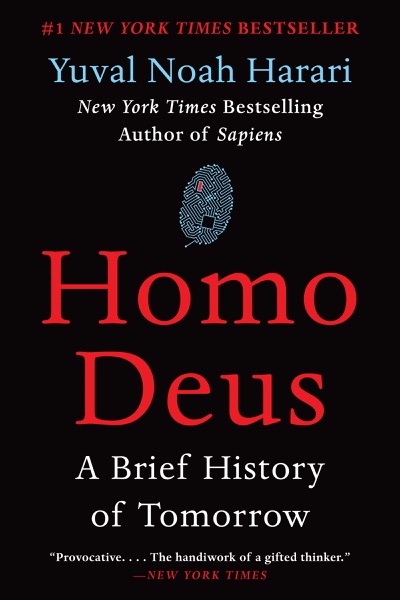
In other words, we will try to upgrade Homo sapiens into Homo deus. That is the title of the book, and he means it almost literally.
Start with death. For all of history, every religion made peace with it. Death gave life meaning. Heaven, karma, legacy, all of it was built around the fact that you end.
Science makes no such peace. To science, nobody ever dies of "old age." People die of specific failures. A clogged artery. A tumor. A worn-out heart valve.
"Name one cause of death that is not technical," the researcher said.

I tried. "Time?"
"Time does not kill anyone. Time is when the failures happen. The failures kill you. And failures are engineering problems."
He was not fringe. Harari points out that serious money agrees with him. Google launched Calico in 2013 with the stated goal of "solving death." Big investors in Silicon Valley talk openly about living to 150 or beyond.
Harari does not predict we will beat death soon. He predicts we will try, hard, with billions of dollars. And a war on death changes everything, because a person who might live for centuries takes no risks, signs no thirty-year truces, and never says "you only live once."
The second agenda item is happiness. Not comfort. Bliss.
Here is the strange finding Harari leans on. We are far richer and safer than our ancestors, yet not clearly happier. Suicide rates in wealthy, peaceful countries are often higher than in poor ones.
Why? Biology. Your good feelings are chemicals, and evolution designed them to fade fast. A promotion feels great for a week. Then your brain resets, and you chase the next hit.
So if happiness is biochemistry, the modern mind draws the modern conclusion. Do not fix the world. Fix the chemistry. Harari notes we already do this at scale, from antidepressants to the pills we give restless kids. The next step is doing it on purpose, for everyone, permanently.
The third item is the biggest. Upgrading ourselves. Three tools are already on the table.
Biological engineering, rewriting our genes. Cyborg engineering, merging bodies with machines, like brain interfaces and bionic limbs. And non-organic engineering, building minds out of code with no body at all.
"We are not curing," the researcher said. "That is the old game. Curing gets you back to normal. The new game is going past normal. Better memory. Stronger immune system. More years."
That line matters. Harari's point is that there is no clean wall between healing and upgrading. Glasses fix bad eyes. Then why not eyes that see in the dark? Medicine slides into enhancement without ever announcing it.
He is careful about one thing, and I want to be careful too. This is not a prophecy. Harari says it is a projection of where our current values point. History can swerve. But when a species stops fearing famine, it starts shopping for divinity.
What does Harari say humanity's new agenda will be after beating famine, plague, and war?
Why does this matter for you? Because the upgrade market will not knock politely. It will arrive as products. A supplement, an app, an implant, each one framed as health.

The move: this week, notice one product pitched to you as "optimization." A tracker, a nootropic, a biohack. Before buying, ask one question in writing. Is this fixing a real problem I have, or selling me a race with no finish line?
Because here is the trap Harari sets up next. We are planning to upgrade humans before we understand them. We talk about better memory and longer life as if we know what a human even is.
But before we upgrade humans, we have to ask what made humans special in the first place. Harari's answer is not intelligence, and it is not tools, and it will change how you see every dollar in your pocket.