Chapter 1 of 1

One Percent Better, Every Day

"Why do my big goals always collapse by February?" Kate asked me.

She sat at my kitchen table with cold tea and a list of failed resolutions.

"Because goals don't work," I said. "Systems do."

She stared at me. "That sounds like a fortune cookie."

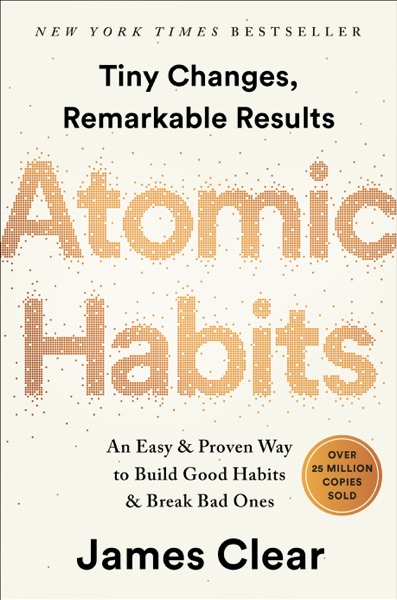
"It's James Clear, Atomic Habits. The whole book fits on one idea. You do not rise to the level of your goals. You fall to the level of your systems."

"Meaning?"

"Winners and losers often have the same goals. The difference is what they do every day."

"Fine," Kate said. "But my days are tiny. A ten minute walk changes nothing."

"That's the trap," I said. "Tiny changes compound. Get one percent better every day and the math goes wild."

37xImprove 1 percent daily for one year and you end up about 37 times better

"Thirty seven times?" she said.

"And it cuts the other way. One percent worse each day for a year drops you to nearly zero. Habits are the compound interest of self improvement."

"Okay, so how do I actually build one?"

"Every habit runs on the same loop. Clear built the whole book around it."

  • Cue
  • Craving
  • Response
  • Reward

"Something triggers you. You want the payoff. You act. You get rewarded, and your brain files it away."

"So?"

"So you push on all four stages. Clear calls them the Four Laws."

"Which are?"

"Make it obvious. Make it attractive. Make it easy. Make it satisfying. Flip them to break a bad habit. Make it invisible, unattractive, hard, and unsatisfying."

"Give me real ones," Kate said. "You know I hate theory."

"Obvious means design your space. Want to run in the morning? Put your shoes by the door tonight. Want less phone time? Leave the phone in another room."

"That's it?"

"Clear also loves habit stacking. Tie the new habit to one you already have. After I pour my coffee, I will write one sentence."

"Attractive?"

"Pair the thing you should do with a thing you love. Only watch your show while you fold laundry. And join people who already have the habit. We copy the tribe we're in."

"Easy?"

"This one saved me," I said. "The two minute rule. Shrink any habit until it takes two minutes."

"Like what?"

"Not read thirty pages. Read one page. Not run three miles. Put on your shoes and step outside. You are not building the workout yet. You are building the identity of someone who shows up."

Kate frowned. "That feels like cheating."

"It feels like cheating and it works. A habit must exist before it can improve. Master showing up first."

"And satisfying?"

"Give yourself a win right away. Mark an X on a calendar. Don't break the chain."

"And when I miss a day?"

"Never miss twice. One skip is an accident. Two is the start of a new habit."

Then I told her the deepest part of the book. Every action is a vote for the type of person you want to be.

Goal thinking

  • I want to run a marathon
  • motivation runs out
  • finish line, then drift
vs

Identity thinking

  • I am a runner
  • every run is a vote
  • no finish line, just a person you become

"Don't say I want to run," I said. "Say I am a runner. Then prove it to yourself with tiny votes, two minutes at a time."

Kate was quiet for a second. "Say the whole thing back to me. Short."

"Forget the goal, build the system. Tiny gains compound. Run the loop through the Four Laws. Cast votes for your identity."

Why do tiny 1 percent improvements matter so much?

"And the three biggest moves?"

Remember this

  • Stack the new habit onto one you already do
  • Shrink it to two minutes and just show up
  • Never miss twice, one skip is fine, two is a new habit

"Try this tonight," I said. "Pick one habit. Shrink it to two minutes. Do it before bed, and set up tomorrow's cue where you can't miss it."

Kate set her running shoes by the door, then turned back. "So what happens when even two minutes feels impossible?" I smiled and said, "That answer belongs to the next book."